Advanced level: 80 Hours - 10 Days
The true and unique full professional experience of orchestral writing and production for images. A curriculum guided by high-profile professionals who daily work as film score composers: from scene analysis to ideation, from mock-up production to realization with one of the world's finest symphonic orchestras of 60 players, up to mixing and final mastering.
A unique educational path organized in three phases that lead from theory to its application on the scene, from composition to the recording of a roughly 3-minute piece by each participant. The course is run step by step under the guidance of the instructors for a total of 10 days of 8 hours over 1 month, after which students will receive the final mastered versions of their compositions, usable for portfolios and professional purposes, with full ownership and rights.
From the theoretical approach of reading the scene to analysis and orchestral writing with the development of a personal style and an aesthetic and functional approach to film scoring. Development of composition on images in relation to shots, environments, visual rhythm, atmosphere, and narrative tension. Construction of the main theme and its role in the emotional structure of the scene. In-depth use of the DAW and digital tools in preparing the writing for real orchestral performance. Optimization for recording with a symphonic orchestra, effectiveness of thematic choices, management of orchestral densities, rationalization of the score for the recording session, balance between musical intention and real orchestral outcome.
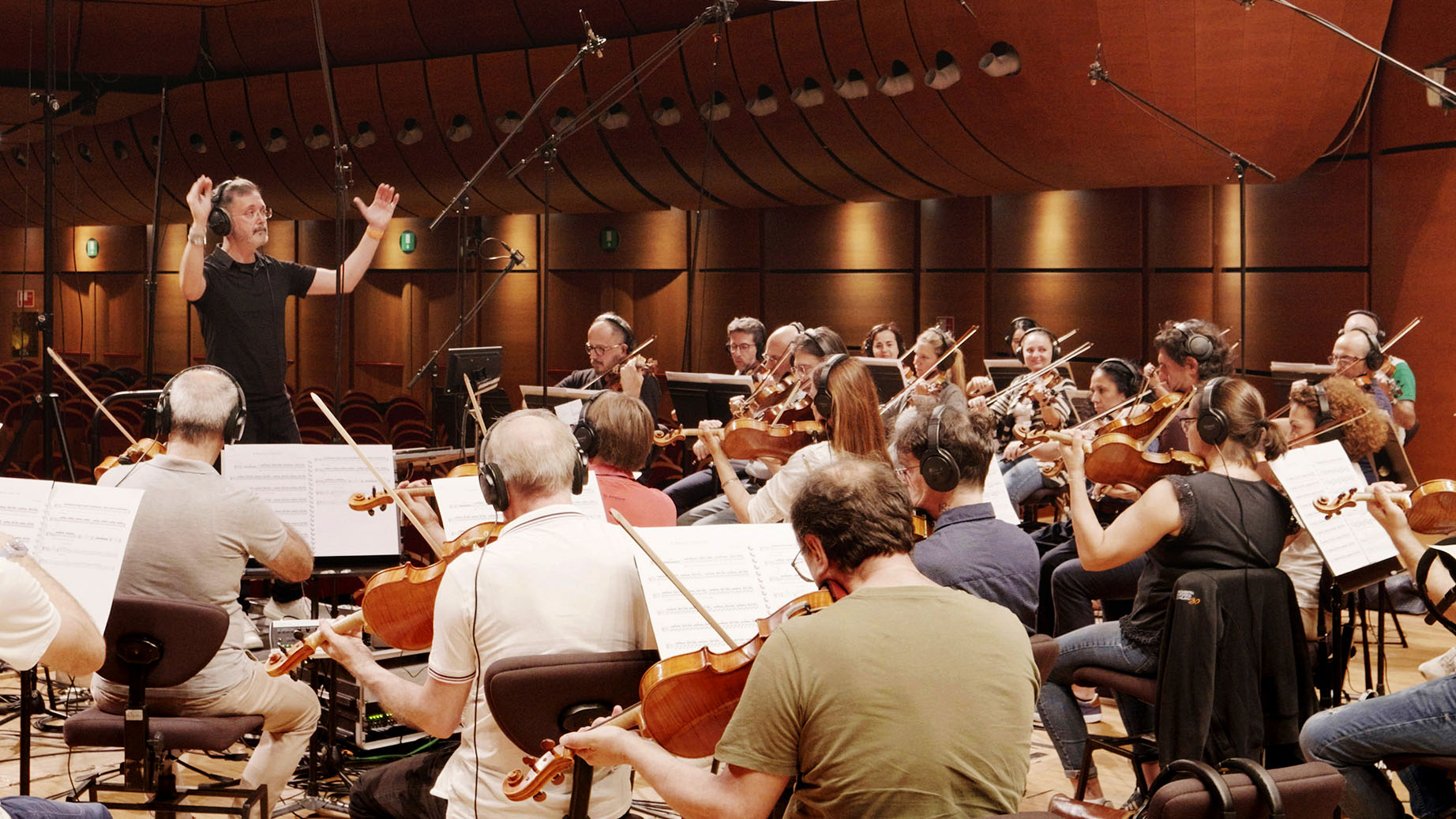
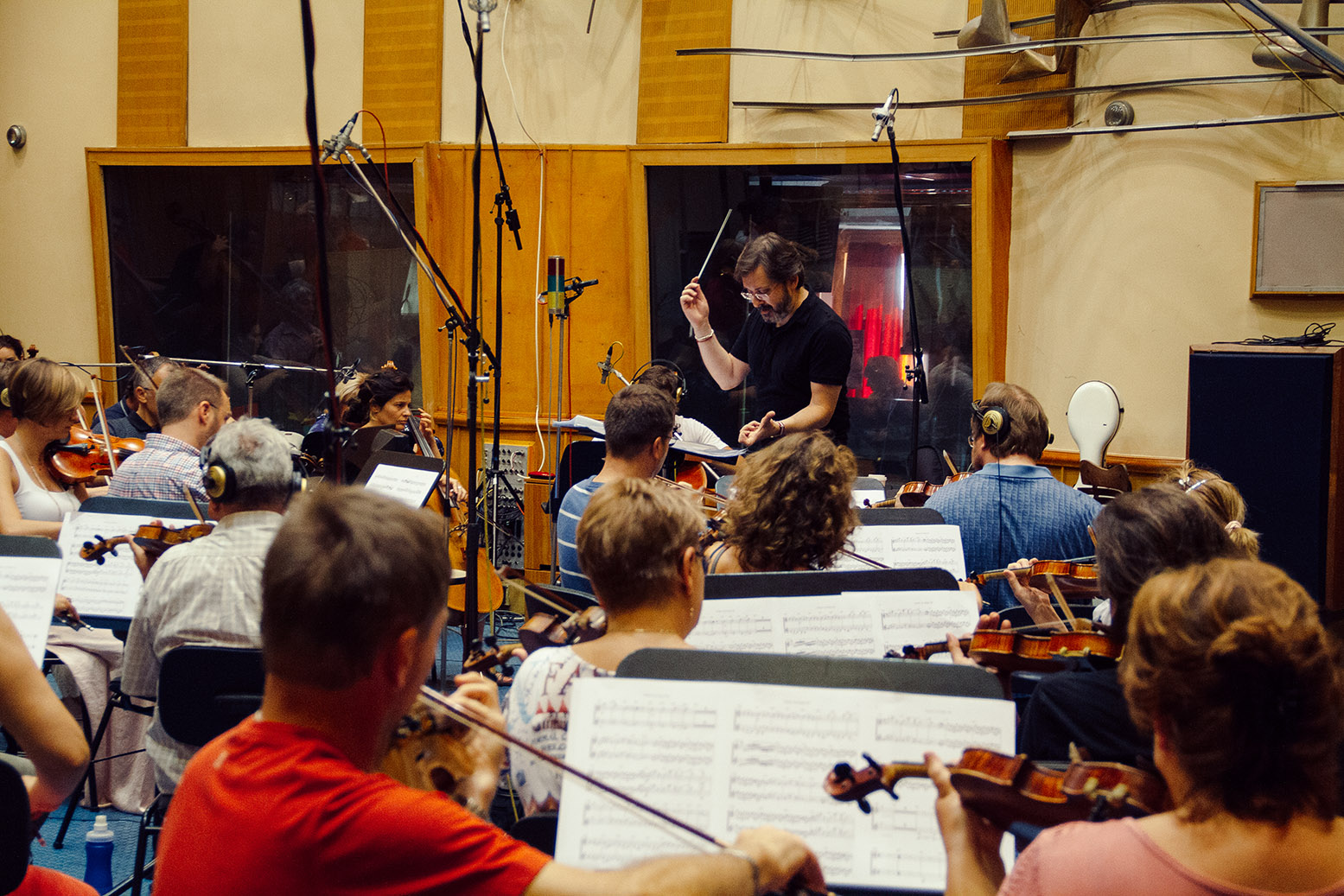
The unique emotion of experiencing the live recording of your own roughly 3-minute piece in an Auditorium, with one of the world's finest 60-piece symphonic orchestras.
Organization of pre-production and preparatory recordings for the Auditorium session, principles of orchestral conducting and communication with the orchestra aimed at effective management of the recording session, professional preparation of scores and orchestral materials intended for performance and recording.
The unique opportunity to follow the live mixing of your piece on the legendary AMS/Neve88 RS 48 console, with outboard gear that made history such as the Teletronix LA-2A and Chandler Limited EMI TG units. The extensive experience of Goffredo Gibellini, one of the most important international sound engineers, responsible for engineering and mixing soundtracks of productions that left a mark — including Paolo Sorrentino's Oscar-winning film “La grande bellezza”, “The New Pope”, and “Youth”, as well as Matteo Garrone's “Pinocchio” with music by Oscar winner Dario Marianelli, among many others. Finalization of the piece with live mastering.
is acquired through experience. The course aims to make the student work with the real-world methodology used daily by professionals who face the challenges of directing creativity applied to audiovisual media in the most efficient and effective way possible. It also allows recording with a large symphonic orchestra the result of one's work while maintaining full ownership of the piece.

* It is recommended to use a small portable MIDI keyboard, equipped with a modulation wheel or an external MIDI controller
The three different phases of the educational path take place in person at three different locations as specified in the calendar. Except for any concessions or agreements available to masterclass participants regarding accommodations, transfers, per diems and overnight stays are NOT included in the participation fee and are the responsibility of each participant.

La Capsula is located in the musicROOMS of BASE Milan (via Bergognone, 34) and is accessible via an independent entrance from external stairs. It is a room dedicated to ideation, listening, production and practical scene development under the guidance of the instructors.

The Auditorium at Largo Mahler in Milan is home to the Orchestra Sinfonica di Milano and is the location where students' pieces are recorded live — an essential moment to deepen one of the key phases of soundtrack production and to live an unforgettable experience.

At the prestigious Digital Records studios in Rome the course concludes with the mixing of the pieces and recordings made during phase two. Live sessions cover editing and audio post-production with the experience of a top-level international sound engineer and hardware that represent the best available on the market.
The path is designed to let students live, step by step, the real professional experience of orchestral production applied to music for images by practitioners who work in the field. From constructing musical meaning on the scene to recording with a large symphonic orchestra, the course covers all stages of the contemporary composer's advanced professional workflow: writing, mock-up, orchestration, score preparation, recording session with symphonic orchestra and finalization of the orchestral product. The objective is to develop full awareness of the relationship between cinematic language, symphonic thinking and real music production.
The program runs over 10 meetings within one month. Attendance requires owning a computer, a hard drive for samples, an installed DAW and a MIDI keyboard/controller.
Course schedule
To be defined.

Presentation of the cinematic scene that will be orchestrated and scored during the course
Analysis of different compositional approaches by major film music authors and their strategies for writing for symphonic orchestra
How the orchestral language of music for images has evolved over time in relation to narration, scene psychology and cinematic language
Development of the composition based on images in relation to shots, environments, visual rhythm, atmosphere and narrative tension
Construction of the main theme and its role in the emotional structure of the scene

The generation of musical meaning within orchestral writing in relation to the proposed scene
Orchestration in film music: development of orchestral thinking, section distribution and dramaturgy within the symphonic system
Advanced use of the DAW (Cubase) and digital instruments in preparing the writing intended for real orchestral performance
Optimization of writing for symphonic orchestra: effectiveness of thematic choices, management of orchestral densities, rationalization of the score for the recording session, balance between musical intention and real orchestral result
The importance of building the correct Tempo Track
Optimization of the orchestral mock-up in the DAW for integrating the real orchestra with electronic or non-orchestral timbres
From the DAW to the score in notation software

Collective analysis of the orchestral sessions produced by students for the proposed scene
Review and commentary on compositional, orchestral and structural choices developed within the DAW
Correction and optimization of scores for musical result and performance with a real symphonic orchestra
Analysis of changes and reworkings needed to improve narrative effectiveness, orchestral balance and score management
Division of students into two working teams supervised directly by the two instructors for the development and refinement of orchestral material

The importance of correct pre-production setup in creating a soundtrack for a large symphonic orchestra
Organization of the most effective and efficient production workflow: management of the orchestral production plan, recording planning, and session optimization
Principles of orchestral conducting and communication with the orchestra aimed at effective management of the recording session
Professional preparation of scores and orchestral materials

Piano recording at Candle Studio Milan as an integral part of building the orchestral soundtrack
Preparation of musical and technical material for the subsequent recording with symphonic orchestra
Organization and setup of pre-production sessions
Optimization of material intended for the recording session

Final development of scores and produced materials
Preparation for the orchestral recording session

Recording at the Auditorium of Largo Mahler in Milan with the 60-piece Orchestra Sinfonica di Milano, sound engineer Goffredo Gibellini, conductor Enrico Goldoni and supervision by instructors Vito Lo Re and Fabrizio Campanelli
Students will experience the real process of recording their compositions performed by a large symphonic orchestra

Analysis and finalization of recorded orchestral material: section balance, depth and spatiality, dynamics of symphonic writing, tonal balance
Integration between orchestra and electronic components

The role of mastering in contemporary orchestral production applied to music for images
Final sonic polishing of the pieces created by the students
Mastering session for the orchestral material produced during the course

Collective listening and final presentation of the orchestral compositions created during the course
Final analysis of the works and discussion of artistic and production results achieved
Awarding of participation certificates
Delivery to students of the final mastered versions of their orchestral compositions

Application submission is free and is made by uploading the works and filling in the online form with deadlines and timings shown on this site
If the evaluation is positive, following notification of eligibility by Scoring For Films, payment of the participation confirmation fee is required as described in the admission communication
Enrollment is completed with the confirmation of the course start and full advance payment of the enrollment fee in the manner indicated
The participation fee for the Masterclass “Scoring For Films - Level II: Orchestra” is a total of €4000.00 + VAT divided into two installments:

Thanks to the support of Fondazione Cariplo and the collaboration of Scuola di Impresa Sociale, the May-June 2026 edition is completely free.
The participation confirmation fee, to be paid within 7 days following the communication of admission and eligibility to the course, is €1500.00 + VAT to be paid via PayPal or bank transfer.
The deposit is non-refundable.
The balance of the enrollment fee, to be paid within two weeks from the communication of course start and calendar confirmation, is €2500.00 + VAT to be paid via PayPal or bank transfer.
The enrollment balance is non-refundable.
Transport, meals and accommodation costs are not included in the participation fee and are entirely the responsibility of each participant. Scoring For Films may assist with travel organization and suggest partner accommodation options with BASE in Milan.


The experience of professionals who really work in the field, serving a curriculum centered on sharing the real needs and requirements of those who face the industry daily.

Has written scores for films such as "How to Grow Up Despite Your Parents" (Walt Disney), "Just a Father", and "Fukushima: A Nuclear Story", a documentary film narrated by Willem Dafoe; he has received nominations for the "David di Donatello Award" (the Italian Academy Award) and the Nastri d'Argento awards. He has composed for many international campaigns for important brands such as Mulino Bianco Barilla, Calzedonia, and Fiat. He won the "Key Award" in 2019 with "In the Magic Wood", the soundtrack for Edison Energia's advertising campaign, and in 2012 with "Lovely On My Hand", the original song, soundtrack of Calzedonia's international campaign with Julia Roberts.

He has conducted over 30 operas in Italy, Austria, Canada, the Czech Republic, Switzerland, Romania, Kazakhstan, Ukraine, Albania, Macedonia, and Bulgaria. After composing music for nearly twenty theatrical productions, documentary scores, and primetime television shows, he has composed film scores such as Donato Carrisi's "The Girl in the Fog" starring Toni Servillo and Jean Reno, "Into the Labyrinth" starring Toni Servillo and Dustin Hoffman, "I Am the Abyss", all films with worldwide distribution. He is also an arranger and orchestrator in the pop and rock field with numerous productions to his credit with internationally renowned artists.

Orchestrator and composer, he holds degrees in Orchestral Conducting from the Conservatory of Parma, in Opera Conducting from the Regia Accademia Filarmonica di Bologna, and in Piano from the Conservatory of Verona. He has worked as an orchestrator and conductor with Fabrizio Campanelli and the Czech National Symphony Orchestra, the Budapest Symphony Orchestra, the Czech Virtuosi of Brno, the Accademia Vivaldiana of Venice, the Haydn Konservatorium of Eisenstadt, the Orchestra Classica of Alessandria, the Coro "Marc'Antonio Ingegneri", and the Accademia Dodekachordon of Verona.

He has recorded and mixed tons of scores for highly successful international films such as Paolo Sorrentino's movies including "The Great Beauty", winner of the Oscar Academy Award, or "Youth" with Michael Caine, "The New Pope" with Jude Law, "Letters to Juliet" with Amanda Seyfried, "Mare of Easttown" with Kate Winslet and countless others.
The application to participate is the first step of the registration process. Complete the form and upload one of your tracks. You will be contacted as soon as possible.
Hans Zimmer
Composer, Academy Award Winner
The information here in is given in compliance with article 13 of Regulation (EU) 2016/679 on the protection of natural persons with regard to the processing of personal data and on the free movement of such data (General Data Protection Regulation or GDPR) to individuals interested in receiving news, information, invitations, publications, announcements and newsletters relating to the activities conducted by Scoring For Films.
"Personal data" (article 4, paragraph 1 of the GDPR) means any information relating to an identified or identifiable natural person ('data subject'); an identifiable natural person is one who can be identified, directly or indirectly, in particular by reference to an identifier such as a name, an identification number, location data, an online identifier or to one or more factors specific to the physical, physiological, genetic, mental, economic, cultural or social identity of that natural person.
"Special categories of personal data" (article 9, paragraph 1 of the GDPR) means personal data revealing racial or ethnic origin, political opinions, religious or philosophical beliefs, or trade union membership, and genetic data, biometric data for the purpose of uniquely identifying a natural person, data concerning health or data concerning a natural person's sex life or sexual orientation.
"Processing" (article 4, paragraph 2 of the GDPR) means any operation or set of operations which is performed on personal data or on sets of personal data, whether or not by automated means, such as collection, recording, organisation, structuring, storage, adaptation or alteration, retrieval, consultation, use, disclosure by transmission, dissemination or otherwise making available, alignment or combination, restriction, erasure or destruction.
For the purposes of the GDPR (article 24) the Data Controllers are:
Candle Studio Srl
Via Paganini, 29
(20900) Monza
Italy
Tiziano Rossetti International Music Academy
Dott. Giov. Polar, 35
(6932) Lugano
Switzerland
As part of our activities as a philanthropic entity, we, Scoring For Films, collect and use personal data provided by you, the data subject, e.g. your personal details, to the extent that is needed and helpful to attain the purposes set out below.
We may collect and use personal data for the following purposes:
Communication and promotion of the activities of our Scoring For Films e.g. news, information, invitations, publications, announcements and newsletters via e-mail; as well as monitoring, analysis and research.
Personal data may be collected also for profiling purposes. Specifically, we may ask you to give information about your municipality and province of residence for the exclusive purpose of informing you about events, activities and projects that concern your place of residence. We may also ask you to specify your areas of interest (environment, arts & culture, social & human services, scientific research) so that you receive communications that are targeted to your preferences.
You can change your preferences at any time.
For the purposes set out above, the legal basis of processing is the consent you, the data subject, give to the processing of your personal data.
In relation to your personal data you can exercise your rights as data subject under the GDPR, namely:
You have the right to withdraw your consent at any time.
The rights set out above can be exercised in writing by sending an email to info@scoringforfilms.com.
Pursuant to article 19 of the GDPR, we shall communicate any rectification or erasure of personal data or restriction of processing requested by you, the data subject, to each recipient to whom your personal data has been disclosed, unless this proves impossible. You as data subject have also the right to lodge a complaint with the Italian Data Protection Authority (Garante per la protezione dei dati personali).
For further information about data subjects rights visit our website at www.fondazionecariplo.it.
We will keep personal data up to 24 months of consent.
Your are free to give or withhold your consent to processing of your personal data for the purposes above. We need your freely given consent to send you news, information, invitations, publications, announcements and newsletters regarding our Scoring For Films's philanthropic activities. Should you deny your consent, we will be unable to send you said communications.
We may disclose your personal data outside of our Scoring For Films for various reasons. In particular, your personal data may be made available to entities providing IT system management on behalf of our Scoring For Films, competent authorities and/or public bodies and supervisory authorities to comply with statutory requirements, PR agencies and firms, and other third parties collaborating with our Scoring For Films for the attainment of our philanthropic purposes. Where appropriate, we shall formally appoint said third parties Data Processors pursuant to article 28 of the GDPR. Upon your request you can access the detailed list of third parties to whom your personal data has been disclosed.
We process your personal data on paper or electronic form and enter your data into relevant databases that may be accessed - hence your data be disclosed to - our Scoring For Films's employees, contractors/consultants interns and other authorised individuals. Said employees, contractors/consultants interns and other authorised individuals may consult, use, process, compare the data as well as carry out any other appropriate action, including using automated means, always in compliance with statutory requirements that ensure, inter alia, protection of the confidentiality and security of the personal data, as well as data accuracy, update and appropriateness to the purposes for which the data is collected and used, as stated above.
Your personal data may be transferred outside of the EU only for the purposes of promoting philanthropic activities, including via social media. In particular, Scoring For Films - the Data Controller - reserves the right to transmit the data to third parties including those outside of the EU that guarantee an adequate level of personal data protection and apply the EU-US Privacy Shield framework.
Weo may make changes and/or additions to this privacy notice including as a result of regulatory changes.